
You Lived With Uncertainty Before Cancer. You Just Never Thought About It.
One of the things nearly every woman who has faced cancer tells me is that she has trouble living with uncertainty.
Not just fear. Uncertainty.
They’re related, but they aren’t exactly the same thing. Fear is an emotional response to a perceived threat. It says, “Something bad might happen.” Uncertainty is the uncomfortable reality underneath it: “I don’t know what is going to happen.”
Sometimes there is fear without much uncertainty. If a large dog is charging toward you, you know exactly what you’re afraid of. But after cancer, the uncertainty itself can begin to feel threatening. You may not have any evidence that something is wrong, yet not knowing what the next scan will show, what a new symptom means, or whether your plans will be interrupted can leave you feeling constantly unsettled.
Cancer did not create uncertainty in your life. Life was uncertain before your diagnosis too. You just didn’t think about it in the same way. Or feel it in the same way.
You could never guarantee that your job would remain secure, that the people you loved would stay healthy, that a relationship would last, or that the future would unfold according to plan. You probably knew that intellectually, but you didn’t wake up every morning thinking about it. Uncertainty was there, quietly, in the background.
Cancer dragged it into the foreground.
It showed you, in a very personal and painful way, that life can change without permission or warning. Once that happens, it can be hard to return to the old assumption that tomorrow will look more or less like today. It’s hard to get those worms back in the can.
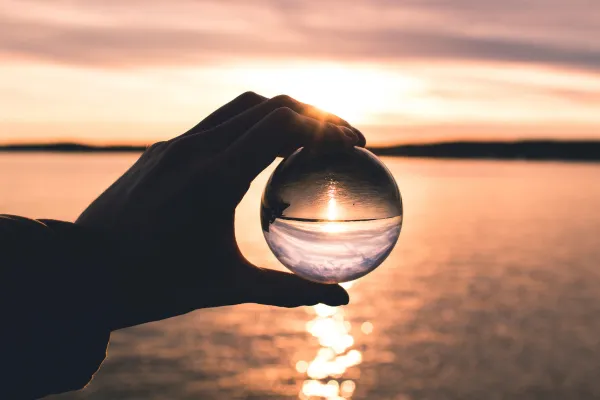
Your brain may start working overtime to find certainty, believing that enough information, vigilance, planning, or worrying will prevent you from being blindsided again. Unfortunately, none of us gets a crystal ball. You can gather information, plan carefully, and pay attention, but you still can't know exactly what comes next.
But when your brain can’t find the guarantee it wants, it may keep circling the same questions, making it harder to make decisions, create plans, or move forward.
Of course, some planning is useful. Paying attention to your body and following up with your medical team matters. Planning responds to what you know and helps you decide what to do next. But worry tries to control what you cannot know. It keeps turning over possibilities that cannot be resolved today, as though thinking about them one more time might finally produce a guarantee.
It won’t.
That is the difficult truth. But it is also where some freedom begins.
Living well with uncertainty is not about convincing yourself that everything will be fine. It's about becoming more comfortable with not knowing and trusting that you can respond to what happens when it happens. The goal is not certainty. The goal is flexibility, self-trust, and the ability to stay connected to the life you are living now.
When your mind races ahead, try asking yourself, “What do I actually know today?” Then ask, “Is there something useful I need to do, or am I trying to solve a future that has not arrived?”
Sometimes there will be an action to take. You may need to make an appointment, ask a question, or gather information. Other times, the next useful step may be to return to your day—to the person in front of you, the meal you are eating, the work that matters, or the small pleasure you almost missed because your mind was somewhere else.
You lived with uncertainty before cancer. You just didn’t realize it because you trusted life enough not to monitor it constantly.
That trust may not return in exactly the same form. Perhaps now it becomes something deeper: not the belief that bad things cannot happen, but the knowledge that you can deal with whatever happens, and the knowledge that uncertainty does not have to take over your life.
You won’t know exactly what comes next. None of us does.
But you can still make plans. You can still love people deeply. You can still look forward to things. You can still enjoy a good day without asking it to prove that more good days are guaranteed.
Uncertainty is part of being alive. It does not have to become the place where you live.
If you, like so many of the women I speak with, are struggling with uncertainty after a cancer diagnosis, you do not have to keep letting it take up so much space in your mind and your life. You can learn to quiet the constant mental scanning, rebuild trust in yourself, and feel more grounded even when you cannot know exactly what comes next.
If you’re ready to explore what that could look like for you, book a call with me. We’ll talk about what you’re struggling with, what you want instead, and whether working together feels like the right next step.
To receive the blog and content like this right to your inbox, click here:
Write to me at [email protected] to let me know what you'd like help with, or book a call:
Click here to book a "From Surviving To Thriving" Breakthrough Call
Release It! ...Forever/
Thriving Beyond Cancer
Premium Coaching
...With Dr. Jill Rosenthal
Email: [email protected]
Copyright 2025 Release It!...Forever LLC