
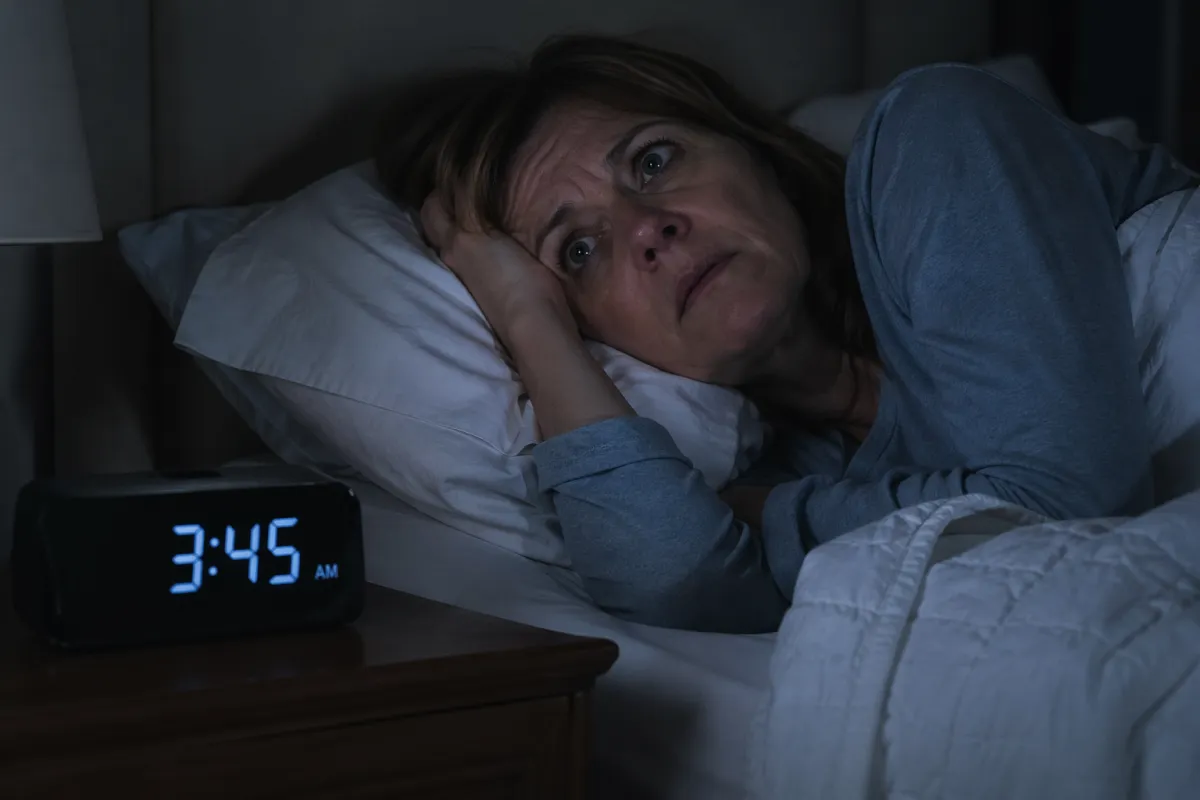
Wide Awake After Cancer? How to Fall Asleep Fast When Your Brain Won’t Shut Up
You’re finally in bed. The lights are out. Your body is tired.
And your brain is like: “Perfect. Now let’s review every uncomfortable scan result, every weird twinge, every conversation you wish you’d handled differently… and also, maybe we should reorganize your entire life at 2:17 a.m.”
Or maybe you do fall asleep… and then you pop awake at 1:48 a.m. or 3:06 a.m. for no obvious reason. (Or because: hot flashes. Or the special joy of getting up to pee every hour.) And once you’re up, your brain decides it’s time to doomscroll the highlight reel of fear.
If you’ve had cancer, this makes extra sense. Your nervous system has learned that nighttime = less distraction = more room for worry. Add in “chemo brain,” hormonal shifts, steroid after-effects, and the way your body can feel extra “loud” in the dark, and your mind can feel like a browser with 47 tabs open—and one of them is playing fear on autoplay but you can’t tell which one it is.
Here’s the bad news: you can’t force sleep. But the good news is you can tell your brain, “We’re not doing the whole meeting right now.”
And you can do it in under 10 minutes—whether you’re trying to fall asleep or trying to fall back asleep.
Try one of these “short wind-downs” tonight (or at 3 a.m.):
1) The 90-second brain dump (2 minutes total).
Keep a notepad by the bed. Take 90 seconds to quickly jot down those thoughts—messy, repetitive, dramatic, all of it. Then channel your inner Scarlett O’Hara and write down: “I’ll think about this tomorrow… after all, tomorrow is another day.” Your brain relaxes when it trusts you won’t forget—and when it knows you’ve officially postponed “the meeting in your head.”
(And yes—this works in the middle of the night too. Especially then.)
2) Physiological sighs (60 seconds).
Two quick inhales through the nose (the second one tops off the lungs), then one long slow exhale through the mouth. Do 3–5 rounds. This is a fast way to downshift the stress response—great for the “wide awake at 2 a.m.” moment.
3) The “name it to tame it” scanxiety reset (3 minutes).
When fear hits, say (out loud if you can):
“This is anxiety.”
“This is my brain trying to protect me.”
“This is not a prediction.”
You’re not arguing with the thought. You’re simply labeling it. That tiny move creates distance—and distance creates calm.
4) Use the free Cancer Chatter Reset app (2–10 minutes).
This is the one for the nights when your brain is already gone. When logic is useless. When you wake up and immediately feel that drop in your stomach—like your nervous system hit the alarm button.
The Cancer Chatter Reset is a guided, interactive online experience you use in the exact moment your fear spikes — not later, not when you “have time.”
You choose the track that matches what’s happening (like symptoms, scanxiety, or random intrusive thoughts) and then you just follow along. No guesswork. It even adapts to how much time you have: a quick 2–3 minute reset or a deeper 8–10 minute reset.
It’s built around evidence-based nervous-system calming tools (like grounding/orienting and tapping) because you don’t think your way out of fear — you signal safety to your body, and your mind follows.
5) The “don’t negotiate with terrorists… especially at 3 a.m.” rule (instant).
When you wake up in the middle of the night, your brain may try to drag you into a negotiation. About symptoms. About scans. About worst-case scenarios. About how you “should” be handling all of this better.
Here’s the move: don’t negotiate with terrorists. Especially at 3 a.m.
That doesn’t mean you try to force the thoughts away (that usually backfires). It means you stop feeding them. Let the thoughts show up… and then let them float past like leaves on a stream. You don’t have to grab each one, analyze it, or answer it.
Give your body something simple and physical instead: a long slow exhale, unclench your jaw, drop your shoulders. If your mind pulls you back into the story, you gently return to the exhale again. No drama. No debate. Just “not engaging.”
One more thing: if you’re lying awake feeling angry that your body “won’t cooperate,” I get it. Cancer messes with trust—trust in your body, your future, your ability to relax.
So the goal here isn’t to do bedtime perfectly. It’s to give your nervous system a consistent signal that the emergency is over—even if your brain is still trying to file an incident report.
Pick one technique. Do it for five nights. Let it be awkward. Let it be imperfect. That’s you taking your power (and your sleep) back.
And tonight? You don’t need an hour. You just need a signal.
And if you’re thinking, “This helps… but my brain is still too loud at night,” that’s a sign you might need more than a few quick tools. You don’t have to figure it out alone. If you want real support turning down the fear, sleeping better, and getting your nights (and your days) back, let’s talk.
To receive the blog and content like this right to your inbox, click here:
Write to me at [email protected] to let me know what you'd like help with, or book a call:
Click here to book a "From Surviving To Thriving" Breakthrough Call

Release It! ...Forever/
Thriving Beyond Cancer
Premium Coaching
...With Dr. Jill Rosenthal
Email: [email protected]
Copyright 2025 Release It!...Forever LLC