
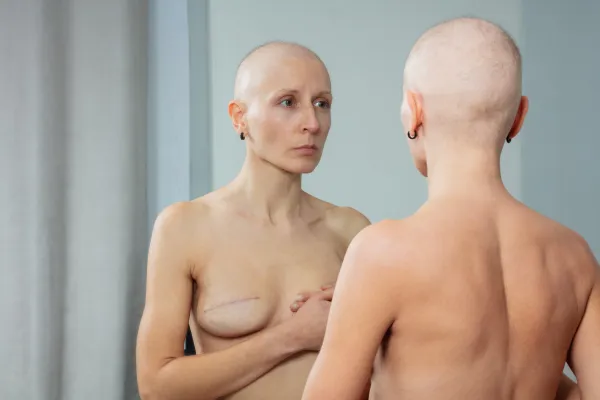
When Your Body Doesn’t Feel Like Yours Anymore: Healing Body Image After Cancer
There’s a version of you that existed before cancer. And you probably miss parts of her that you took for granted until surgery, radiation, or chemotherapy changed your body.
Before cancer, you more or less knew what to expect when you looked in the mirror or got dressed. You might not have felt like a supermodel, but seeing yourself naked might not have hit the way it does now.
Because cancer doesn’t just change your body. It changes the relationship you have with your body, and with yourself.
For most women, body image after cancer treatment isn’t necessarily their biggest struggle. It’s just one more thing… always there. Like an annoying background app draining your battery. You can be functioning, working, parenting, rebuilding your life—and then you step out of the shower or see yourself in the mirror and suddenly you don’t even recognize yourself.
And what makes it so intense is that it’s often not just one single change. It’s the pile-up of changes.
Scars. Swelling. Numbness. Tightness. Hair loss and skin aging. Weight gain. Menopause symptoms you didn’t ask for, like hot flashes and sleep disruption. Fatigue that limits what your body can do in a day. Even if you “look fine,” you may not feel like yourself. That gap—between how you appear on the outside and how you experience yourself on the inside—can mess with you in a way that’s hard to explain to people who haven’t lived it.
Here’s one example (and it’s only one example): Before surgery, your doctor might say, “You’ll look great in clothes.” And friends and family may tell you the same afterward. People mean well. And you probably do look great in clothes. But it misses the point, because what’s bothering you isn’t about what you look like in clothes—it’s how you feel.
You’re living your external life fully dressed.
But your internal life is lived in your body and your mind. You’re the one who has to stand in front of the mirror and feel at home there. Wanting to like what you see is not vain or shallow. It’s human. It’s valid. Your body has been through trauma, loss, and repeated procedures. Your nervous system and your self-image don’t just snap back because a surgery is “done.”
Nothing is wrong with you for feeling this way.
Of course you’re struggling.
This is a lot to carry.
A lot of this is grief. And grief doesn’t respond well to being argued with. If you’ve been trying to talk yourself out of your feelings—it usually goes like this:
I should be grateful.
I shouldn’t care.
It could be worse.
Notice how that usually goes. You don’t feel better. You just feel guilty for not feeling better.
So what actually helps?
Not forcing “body love.” Not slapping affirmations over pain. Start with something simpler: body neutrality. The goal is to stop fighting your body like it’s the enemy for what it’s done to you, or for what your treatment has done to you.
Try this the next time the loop kicks in:
Name it: “This is grief.”
Validate it: “Of course I’m having feelings. My body has been through a lot.”
Choose one caring action: water, a walk, rest, stretching, talking with a friend, putting on clothes that don’t punish you.
And consider this practice: spend 30-60 seconds looking in the mirror and describe what you see like a compassionate reporter. No scanning for flaws. No insults. Just facts. At first it might feel awkward or emotional. That’s okay. You’re not trying to convince yourself you look amazing. You’re retraining safety. You’re teaching your brain: I can look in the mirror and stay connected instead of melting down or attacking myself.
If the mirror exercise feels too hard, try this instead:
Imagine you are looking at a 5-year-old version of yourself. What would you tell her? Not just reassurance that tries to talk her out of it or negates her feelings, but truly acknowledging her so she feels seen.
This work applies to all kinds of post-treatment changes—not just one diagnosis or one body part. We don’t have to love every symptom or side effect. But we also don’t have to stay permanently stuck in the misery they can cause. Sometimes the most powerful shift is moving from “I hate this” to “I don’t like this… and I can still take care of myself inside it.”
And if you try these steps and still feel stuck, that doesn’t mean you’re failing. It might simply mean you need deeper healing than trying to think your way out of it. If you want support with your post-cancer body image—so you can feel more like yourself again—I’m here. Message me.
To receive the blog and content like this right to your inbox, click here:
Write to me at [email protected] to let me know what you'd like help with, or book a call:
Click here to book a "From Surviving To Thriving" Breakthrough Call

Release It! ...Forever/
Thriving Beyond Cancer
Premium Coaching
...With Dr. Jill Rosenthal
Email: [email protected]
Copyright 2025 Release It!...Forever LLC